Shifts in Player Habits Across Roulette Variants When Paired with Evolving Payment Options and Self-Management Features in Digital Spaces
Écrit par Ben Schwarz · 15/10/2026

Shifts in Player Habits Across Roulette Variants When Paired with Evolving Payment Options and Self-Management Features in Digital Spaces
Player engagement with online roulette has evolved as payment systems and self-management tools have become more integrated into digital platforms, with researchers tracking changes across European, American, French, and live dealer formats throughout 2026. Data from regulatory bodies indicates that instant transfer methods and cryptocurrency options have altered session lengths and bet sizing patterns, while features such as deposit caps and reality checks show measurable effects on variant selection. Observers note that these combinations appear most frequently in jurisdictions where online gaming expanded rapidly after 2023, creating datasets that allow comparisons between traditional card-funded play and newer digital wallet activity.
Roulette Variants and Their Digital Footprints
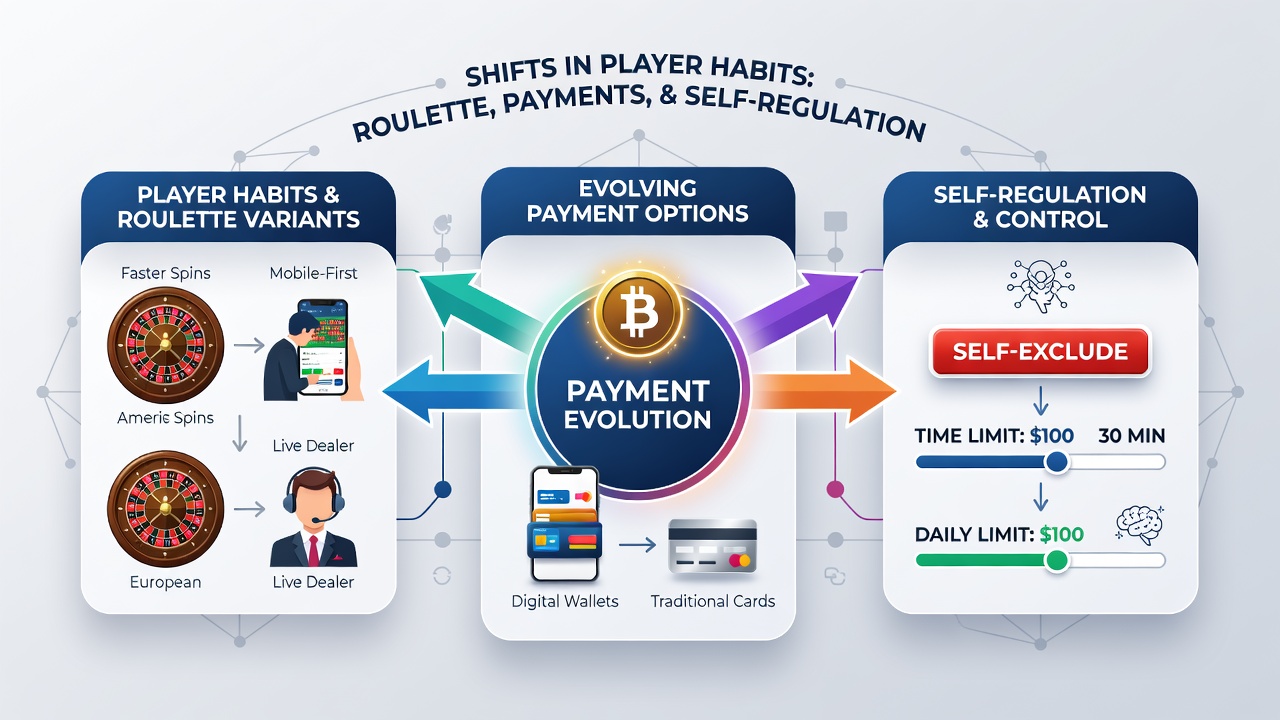
European roulette maintains a single zero and carries a house edge near 2.7 percent, whereas American roulette incorporates both a zero and double zero, raising the edge to 5.26 percent, and French roulette adds rules like la partage that return half the stake on even-money bets landing on zero. Live dealer streams replicate these mechanics in real time, while random number generator versions run continuously without human interaction. Studies compiled by the Alcohol and Gaming Commission of Ontario reveal that players accessing European adn French variants through e-wallets complete more spins per hour on average than those using credit cards, particularly when session reminders activate automatically after 30 minutes. American roulette, by contrast, draws fewer extended sessions once loss-limit tools engage, suggesting the higher variance interacts differently with preset spending boundaries.
Payment Evolution and Session Dynamics
Payment landscapes shifted further in 2025 and 2026 as platforms introduced stablecoin settlements and bank-to-wallet transfers that settle in seconds rather than days. Figures released by the Australian Communications and Media Authority show a 34 percent increase in cryptocurrency-funded roulette accounts between January and September 2026, with those accounts demonstrating shorter but more frequent logins across all variants. European wheels paired with instant methods record higher average bet values per spin, while American wheels see elevated use of minimum-bet tables when players activate time-based limits. The pattern holds across multiple operators, indicating that reduced friction in funding correlates with variant-specific adjustments rather than uniform increases in activity.
Self-Management Tools and Behavioral Adjustments
Self-management features now include customizable deposit ceilings, loss thresholds, cool-off periods, and mandatory reality checks that interrupt play with expenditure summaries. Research conducted through academic partnerships with Canadian provincial regulators demonstrates that players who set weekly loss limits reduce their time on American roulette tables more sharply than on European or French equivalents, possibly because the double-zero structure amplifies the visibility of cumulative losses during check-ins. Live dealer formats, which often incorporate chat functions and slower pacing, show smaller reductions in participation when the same tools activate, suggesting social elements may moderate the impact of automated pauses. In October 2026, several platforms reported updated dashboards that link payment history directly to these controls, allowing users to view funding sources alongside limit compliance metrics.
Combined Effects Across Regions and Platforms
Cross-jurisdictional comparisons highlight that markets with mature self-exclusion registries, such as those in parts of Canada and Australia, record steadier declines in high-variance roulette play once digital wallets become primary funding sources. Players who toggle between variants within a single session tend to migrate toward lower-edge options after receiving mid-session summaries, a movement documented in aggregated operator data shared with research consortia. Payment reversibility features, including those offered by certain e-wallet providers, further influence habit formation because they reduce perceived risk during initial deposits yet trigger additional limit-setting once reversals occur. The result is a measurable redistribution of play volume rather than outright cessation, with European and French variants absorbing portions of activity previously directed at American wheels.
Conclusion
Available records from October 2026 onward indicate that the intersection of faster payment rails and granular self-management options continues to reshape how participants distribute their activity across roulette formats, with variant-specific responses emerging consistently in tracked datasets. Regulatory reports and platform analytics together establish that these shifts occur without requiring changes to game rules themselves, relying instead on the friction or facilitation introduced at the account level. Continued monitoring by independent bodies will clarify whether these patterns stabilize or evolve further as additional payment and control innovations reach wider adoption.